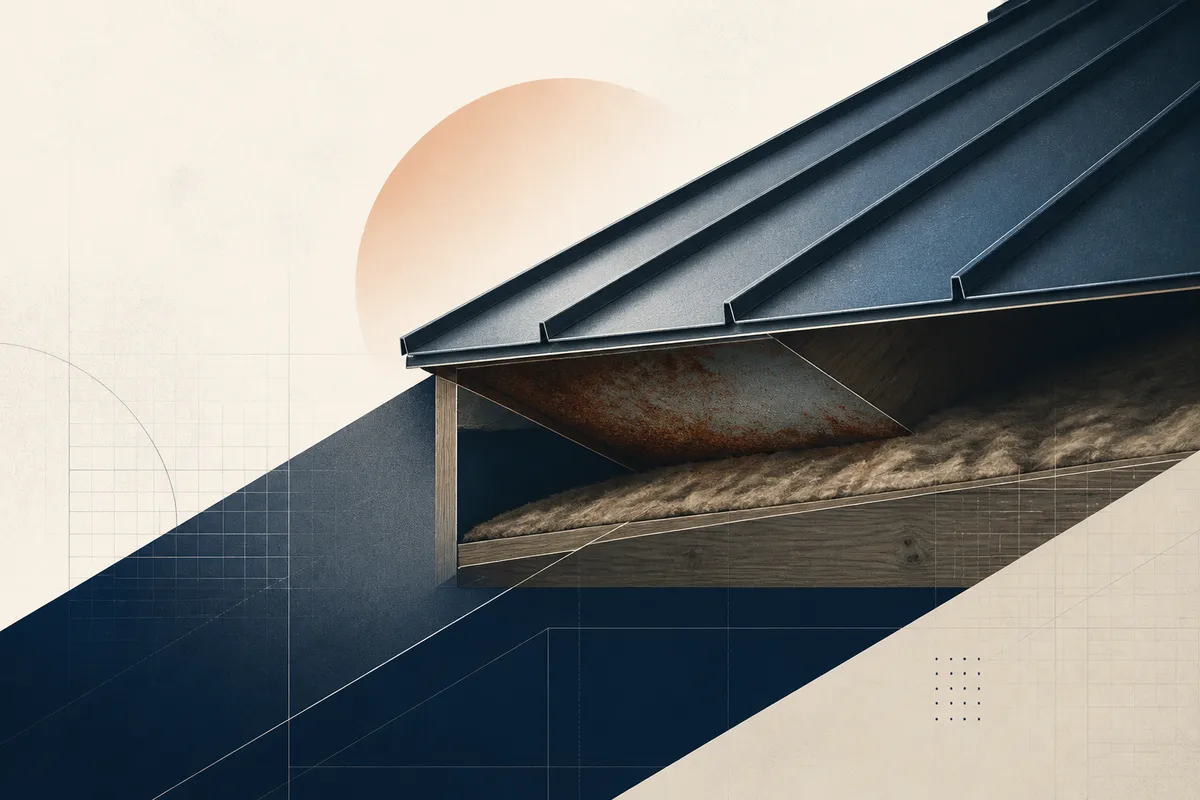
The Attic Effect: Why Metal Roofs Rust from the Bottom Up
Most property owners assume a metal roof fails from the outside in, battered by UV rays and hail. In reality, destructive corrosion often begins on the concealed underside of the panel, driven by thermal management issues in the attic space. When warm, humid indoor air hits cold metal surfaces, it creates condensation on the underside of the panel (cmi-insulation.com). This persistent moisture keeps the metal substrate in a state of constant saturation.
This guide breaks down the mechanics of underside oxidation and edge creep for property owners who prioritize long-term asset protection. Understanding how moisture interacts with metal substrates is essential for anyone considering a transition from asphalt shingles to more durable materials in high-humidity climates.
Why Standard Metal Installations Fail in the Piedmont
Traditional roofing logic often ignores the microclimate created between the roof deck and the metal panel. In humid subtropical environments, standard installations fail for specific technical reasons:
- Improperly vented soffits prevent cool air intake, allowing stagnant, moist air to collect at the peak of the roof structure.
- Cut edges on panels lack the factory-applied protective coatings found on the flat surfaces, leaving the steel core vulnerable to capillary action.
- Low-quality underlayments can trap moisture against the metal rather than allowing the system to breathe or drain.
- Fastener over-tightening on Screw-Down Metal Roofing can create depressions where moisture reaches bare steel through a damaged fastener hole (midfloridametalroofingsupply.com).
The Playbook for Preventing Invisible Corrosion
Managing metal roof underside corrosion requires shifting focus from the visible finish to the internal air exchange. Elevated temperatures hasten the diffusion of material components and accelerate deleterious chemical reactions (wbdg.org).
1Balance the Ventilation Ratio
A roof is only as durable as its ventilation system. The standard goal is to achieve a balanced 1:1 ratio between intake air at the eaves and exhaust air at the ridge. Without this flow, the underside of the metal panel becomes a dehumidifier, pulling water out of the air every evening as temperatures drop.
2Prioritize Cut-Edge Protection
When a panel is cut to fit a valley or hip, the raw steel edge is exposed. In humid climates, this leads to edge creep—rust that starts at the cut and migrates under the paint. Exposure to the weather causes the panels to rust, and treating the corrosion early with a high-performance coating is necessary to prevent further damage (facebook.com/cladspray/posts/1675820897876286/).
3Deploy High-Temp Underlayments
Standard felt paper is insufficient for metal systems because it can degrade under the high heat transferred through the panels. A synthetic, high-temperature underlayment acts as a secondary drainage plane. This ensures that any condensation forming on the underside of the panel rolls down to the gutter rather than soaking into the wood decking.
4Optimize the Attic Insulation Envelope
Rust is often a symptom of heat loss from the living space. If the attic floor is not properly sealed, warm air from the home carries moisture into the attic, where it hits the cold metal. Ensuring a tight thermal envelope reduces the total moisture load the ventilation system must handle.
The Mechanics of Edge Creep and Substrate Failure
Underside corrosion is primarily driven by moisture entrapment combined with limited drying potential (liquasil.com). When the protective zinc or aluminum-zinc coating is breached at a cut edge or scratch, the underlying steel is exposed to moisture. In the Piedmont, where summers are long and dew points are high, this reaction can be continuous. Once the rust takes hold under the paint film, it lifts the coating and exposes more steel, creating a feedback loop that compromises the panel.
If the oxidation is caught before it compromises the core thickness, a metal roof coating system can be used to stabilize the surface. This typically involves cleaning the substrate, applying a rust inhibitor, and sealing the edges with a high-solids membrane to block further oxygen and moisture intrusion.
Managing Your Roofing Project in Charlotte
A professional metal roofing project begins with an audit of the existing ventilation and decking. In the local service area, building codes require specific permits for structural changes. According to the City of Charlotte, building permits are generally required for new construction and additions.
A sound scope of work should include a detailed plan for eave and ridge ventilation, the specific type of underlayment to be used, and the method for treating field-cut edges. Inspections of the attic space help identify existing moisture markers before new panels are installed.
Frequently asked questions
Does a metal roof cause more condensation in the attic?
Metal itself does not create moisture, but its high thermal conductivity makes it reach the dew point faster than other materials. If an attic is poorly ventilated, the metal panel provides a cold surface for existing indoor humidity to liquefy. Proper airflow prevents this by keeping the underside of the metal closer to the ambient outdoor temperature.
How can I tell if my roof is rusting from the underside?
Look for "weeping" rust stains along the drip edge or at the seams where panels overlap. In the attic, check for dark water stains on the plywood decking or rusted heads on the underside of roofing nails. When moisture forms underneath a zinc roof it can form white rust that can eventually damage the roof if not eliminated (designandbuildwithmetal.com).
Is Galvalume immune to edge creep in humid areas?
Galvalume offers superior protection compared to traditional galvanized steel because its aluminum-zinc alloy heals itself at small scratches. However, it is not immune to edge creep in high-humidity environments if the cut edges are constantly exposed to trapped moisture. The "inside-out" rust phenomenon is more about the environment than the material quality alone.
Can I spray foam the underside of a metal roof to stop rust?
Closed-cell spray foam can stop condensation by preventing air from touching the metal, but it must be applied directly to the substrate with zero gaps. This creates a "hot roof" design which changes the thermal dynamics of the building. Before considering this, consult the local building department as building permits are generally required for additions and significant structural modifications.
How often should a metal roof be inspected for hidden damage?
Periodic professional inspections are recommended to maintain the integrity of the roofing system. An inspector should look specifically at the fastener gaskets and the condition of the panels from within the attic crawlspace. Catching underside corrosion early allows for localized repairs rather than a full system failure.
What happens when you get in touch: you describe the situation, we ask the few questions that actually change the answer, and you get a clear scope and next step — no obligation.